

Table of Contents
LA bichectomy is one of the least invasive and most visually impactful facial plastic surgery procedures. In the last five years, its popularity has grown steadily among patients aged 20 to 40 who seek a more streamlined face with defined cheekbones. However, it is not a suitable procedure for everyone, and the results depend largely on the candidate's bone structure and the surgeon's technique.
1. What is a bichectomy and what exactly is removed?
Bichectomy—also spelled bichetomy or referred to as Bichat's fat pad removal—is a surgical procedure that involves the partial or total removal of the Bichat's fat pad, an encapsulated fat deposit located in the middle cheek area, between the buccinator muscle and the masseter and zygomatic muscles.
This fat pad was first described by the French anatomist Marie François Xavier Bichat in the late 18th century, hence its name. Unlike common subcutaneous fat, the Bichat's fat pad is an autonomous, encapsulated structure that does not reduce with weight loss or physical exercise. Its presence gives the face a rounded or childlike appearance, regardless of the person's body weight.
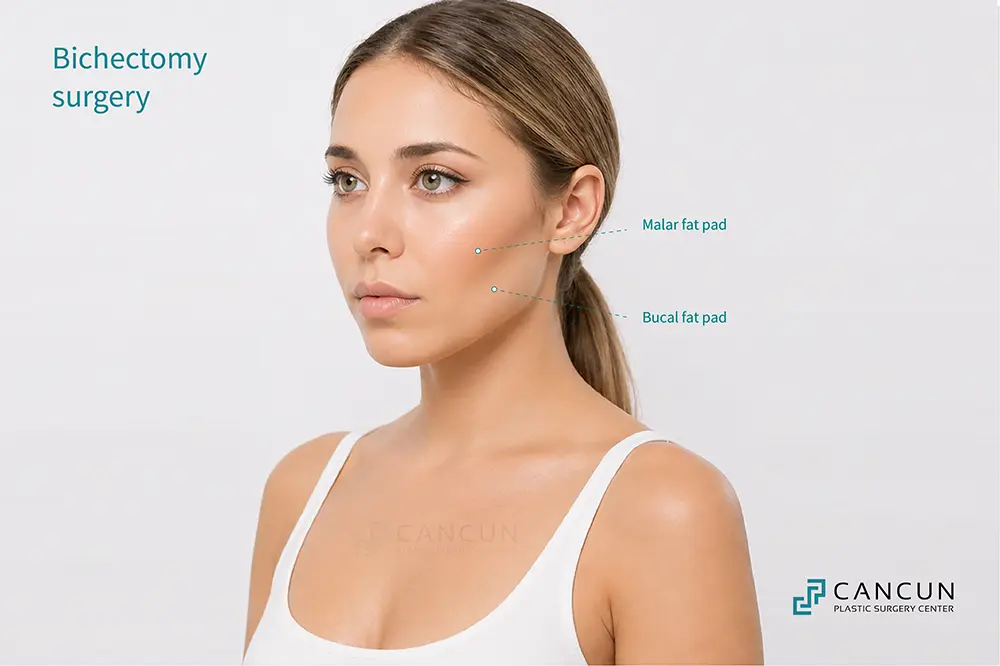
Bichectomy surgery
Identification of facial fat pads treated during a bichectomy to improve facial contour.
The extraction of this structure allows the cheekbones and jawline to stand out more clearly, creating a slimming and facial definition effect that many patients seek. The result is a face with greater angularity, closer to the contemporary aesthetic ideal of stylized facial structures.
2. Who is the ideal candidate and who is not?
The preoperative evaluation for a bichectomy goes far beyond the patient's mere willingness. The plastic surgeon must analyze in detail the facial bone structure, subcutaneous fat volume, skin tone, and, crucially, the projected aging of the face in the medium and long term.
The ideal candidate is someone between 20 and 45 years old, with a stable body mass index, who has a round or square face with voluminous cheeks that do not respond to weight loss. They should have good cheekbone projection and a bone structure that, upon releasing cheek volume, shows natural and harmonious definition.
Conversely, a buccal fat removal is not recommended for people with very thin or narrow faces, for patients who have recently lost significant weight, or for young people under 20 whose facial structure has not yet completed its development. It is also not indicated for patients showing early signs of facial ptosis (tissue sagging) or skin with poor elasticity, as the removal of the buccal fat pad can accentuate these traits over time.
This last point is especially important: the Bichat's fat pad serves a structural function of supporting facial tissue. With natural aging, facial volume tends to decrease. In patients predisposed to thin faces, a bichectomy can generate a pronounced aging effect between the ages of 45 and 55, when tissue naturally loses volume. Good surgeons clearly inform patients of this risk before proceeding.
3. What is the step-by-step procedure?
Bichectomy is an outpatient procedure that is generally performed under local anesthesia with intravenous sedation, although in some cases it can be done with simple local anesthesia if the patient prefers it and the surgeon deems it appropriate. The total duration is between 30 and 60 minutes, depending on whether both cheeks are worked on simultaneously—which is usual—or on the complexity of the case.
The surgeon makes a small incision of approximately one centimeter in the inner lining of the cheek, inside the mouth, so no visible scar remains externally. Through this incision, the buccal fat pad is located and removed partially or totally depending on the desired volume and preoperative evaluation. The incision is closed with absorbable sutures that do not require removal.
The fact that the incisions are internal—inside the mouth—is one of the aspects most valued by patients, as it eliminates any external trace of the procedure. This differentiates a buccal fat removal from other facial procedures that do leave scars on the skin.
4. Recovery: what to expect at each stage
The recovery from a bichectomy is considerably simpler than that of other major facial surgery procedures. However, it requires discipline in following the post-operative protocol to avoid infectious complications, given that the incisions are in contact with the oral environment.
During the first 48 to 72 hours, the patient experiences visible facial swelling—which paradoxically can make the cheeks look fuller than before surgery—mild pain manageable with oral pain relievers, and a feeling of internal tightness in the cheeks. The diet during this period should be liquid or soft, at room or cool temperature, avoiding foods that require intense chewing.

bichectomy-before-after-facial-contour-cheeks-jawline-definition-cancun.webp
Buccal fat removal results: reduced cheek volume and increased facial contour definition in a female patient.
Oral hygiene is fundamental from day one: the use of antiseptic mouthwash after each meal is recommended to reduce the risk of incision infection. The stitches, being absorbable, disappear on their own between days 10 and 21 without needing to be removed.
Facial swelling begins to visibly reduce starting from the second week. By the fourth week, most patients can already appreciate the contours of the result, although the final result does not stabilize until three to four months, when the tissue has completed its reorganization process.
The patient can resume low-demand daily and work activities between the third and fifth day. It is recommended to avoid intense physical exercise during the first two weeks and direct sun exposure on the face for at least four weeks.
5. Results: When they are seen and how durable they are
The first partial results begin to be noticeable between the third and fourth week, when the postoperative edema has significantly subsided. The final result, with the facial contour in its definitive state, can be appreciated from the third or fourth month.
Regarding durability, the results of a buccal fat removal are permanent in the sense that the removed buccal fat pad does not regenerate. However, it is important to clarify that the appearance of the face will continue to evolve with natural aging: facial volume loss and tissue sagging that occur over the years can make the results of a buccal fat removal look different at 50 than at 30.
This is why some facial surgeons prefer a partial—rather than total—removal of the buccal fat pad, preserving a residual volume that cushions the long-term effects of aging without compromising the desired aesthetic results in the short and medium term.
6. Real Risks, Limitations, and Contraindications
Like any surgical procedure, a bichectomy carries risks that must be clearly communicated to the patient before the intervention. The most frequent risks include infection of the intraoral incisions—preventable with proper hygiene protocol—asymmetry between both cheeks if the extraction is not uniform, and injury to the facial nerve if the dissection is not performed with adequate precision. This last risk, although rare, underscores the importance of choosing a board-certified plastic surgeon with specific expertise in facial surgery.
Another important limitation is that a buccal fat removal surgery does not correct jowls, nasolabial folds, or other signs of facial aging. It is a contour-redefining procedure, not a rejuvenation one. Patients seeking a lifting effect or correction of sagging skin should discuss complementary or alternative procedures with their surgeon.
Absolute contraindications include pregnancy, breastfeeding, active autoimmune diseases, uncontrolled coagulation disorders, and active oral infections at the time of surgery. Relative contraindications, which the physician will evaluate on a case-by-case basis, include smoking, uncontrolled diabetes, and a history of keloid scarring.
7. Buccal Fat Removal in Cancun: Why Choose Us
At Cancun Plastic Surgery Center, buccal fat removal is part of our facial plastic surgery program, performed by surgeons certified by the Mexican Council of Plastic, Aesthetic, and Reconstructive Surgery (CMCPER) with specific experience in facial definition procedures.
Each patient undergoes a detailed preoperative consultation during which facial morphology is assessed, outcome expectations are discussed, and long-term projection is analyzed. We never recommend a buccal fat removal if the evaluation indicates that the result will not be harmonious with the patient's facial structure, even if the procedure is among their goals.
For international patients, we offer pre-travel virtual consultations, coordination of accommodation and transportation during the recovery stay, and remote post-operative follow-up after returning to your home country. The minimum recommended stay for a buccal fat removal surgery is five to seven days.
8. Frequently Asked Questions
Can a buccal fat removal be combined with other procedures?
Yes. It is common to combine it with mentoplasty (chin augmentation with an implant or hyaluronic acid), rhinoplasty, or botulinum toxin application in the masseter muscle—to reduce jaw volume—in the same session, optimizing recovery time.
Does it hurt a lot during recovery?
Postoperative pain is generally mild to moderate and is well controlled with oral pain relievers. The main discomfort is usually dietary restrictions for the first few days and a feeling of facial tightness, not severe pain.
When can I eat normally again?
Liquid and soft diet for the first five to seven days. Starting the second week, most patients can incorporate moderately chewable solid foods. A regular diet is generally resumed between 14 and 21 days.
Is there a risk that one cheek will look different from the other?
Asymmetry is one of the risks to watch out for. A surgeon with experience in facial procedures works with symmetry in mind during extraction and performs a comparative evaluation before closing the incisions. However, minor residual asymmetries from swelling may be present during the first few weeks and resolve over time.
There isn't a specific recommended age for a buccal fat removal surgery. However, it's generally advised that patients be at least 18 years old and have achieved facial maturity.
Most specialists recommend waiting until 20-22 years of age, when facial development has concluded. The ideal range is between 22 and 40 years old. From 40 onwards, the evaluation should be especially careful depending on tissue laxity and aging projection.
What happens if I gain weight after a buccal fat removal?
Weight gain can increase the volume of general subcutaneous facial fat, but it does not regenerate extracted buccal fat. The definition effect can decrease with significant weight gain, but it does not disappear completely.
Can a buccal fat removal be reversed?
No. Once the Bichat fat pad is removed, the procedure is irreversible. This underscores the importance of a thorough preoperative evaluation and choosing a surgeon who honestly informs about the suitability of the procedure for each specific case.
Understanding the recovery process before undergoing liposuction is an essential part of making an informed and responsible decision.

