
Table of Contents
LBreast augmentation is the most performed plastic surgery procedure in the world, according to ISAPS annual data. In Cancun, thousands of international patients choose this procedure every year, attracted by the combination of certified surgeons, internationally recognized brand implants, and real savings of between 40% and 55% compared to US prices. This guide answers all the questions a patient asks before deciding.
1. What is breast augmentation and what are its types?
Breast augmentation is a surgical procedure that increases the size, modifies the shape, or improves the symmetry of the breasts. There are two main approaches to achieve this: the placement of silicone implants—the current standard in cosmetic breast surgery—and autologous fat transfer, also known as fat grafting, which uses the patient's own body fat.
In silicone implant surgery, the variables that determine the outcome are the implant shape, projection profile, surface texture, and surgical approach. Each of these decisions is made on an individualized basis during the preoperative consultation, depending on the patient's anatomy, her expectations, and the surgeon's aesthetic judgment.
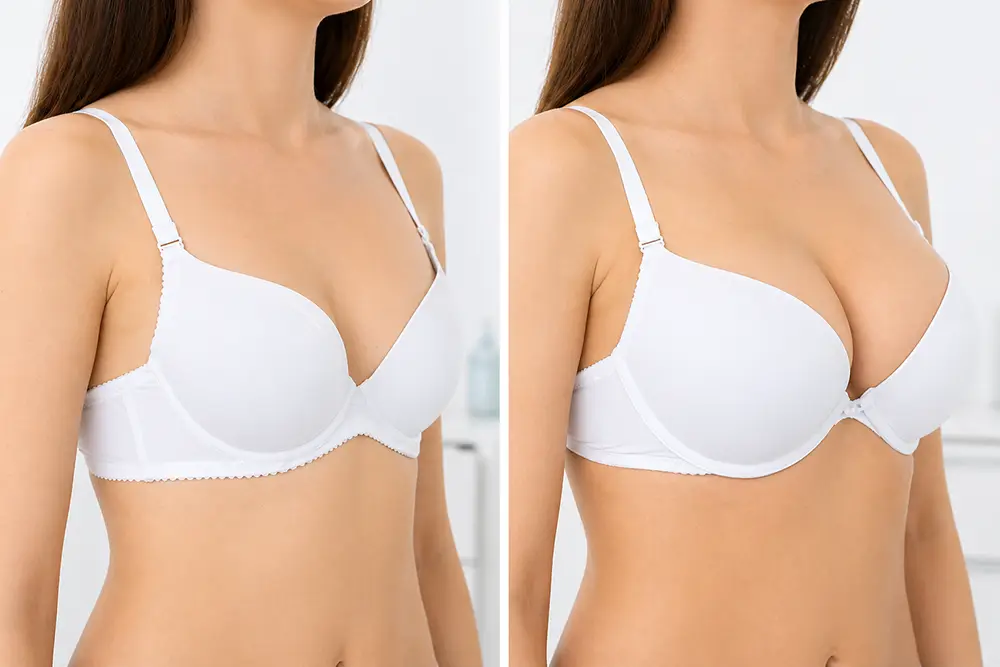
Breast Augmentation Results: Natural Before and After Comparison
Before and after breast augmentation comparison with natural results, increased volume, and better projection.
The choice between implants and fat transfer depends on anatomical factors: fat transfer is suitable for moderate volume increases—generally one to two cup sizes—and requires the patient to have sufficient fat available for extraction. For more significant volume changes, silicone implants remain the most predictable option in terms of the final result.
2. Types of Silicone Implants: How to Choose the Right One
In current aesthetic plastic surgery practice, cohesive silicone implants are the undisputed standard. Other alternatives, such as saline implants, have become largely obsolete in aesthetic breast surgery due to their limitations in feel, natural appearance, and durability.
The first variable is the shape: round or anatomical. Round implants are the most commonly used; they offer uniform volume in the upper and lower poles and are less sensitive to small displacements. Anatomical implants—teardrop-shaped—replicate the natural fall of breast tissue and are indicated for patients with very little native tissue or in reconstruction cases, although they require greater precision in placement to maintain their correct orientation.

Breast implant shapes
Types of breast implant shapes for breast augmentation based on aesthetic goals
The projection profile — low, moderate, high, or extra-high — determines how much the implant projects forward in relation to its base diameter. This parameter is calculated based on each patient's breast base width: choosing an inadequate profile can result in a disproportionate outcome even with the correct implant size.
The surface texture can be smooth or microtextured. Smooth implants have greater mobility and natural movement; microtextured ones offer some adherence to surrounding tissue, which is advantageous for anatomical implants to maintain their position. Both options are safe and widely used.
In reference centers like the CPSC, only implants with FDA and Mexican COFEPRIS approval are used, with a lifetime manufacturer's guarantee in case of breakage. Each implant placed is registered with a lot number and complete traceability, documentation that is given to the patient upon completion of the procedure.
3. Breast fat transfer: the implant-free alternative
Breast fat transfer, or lipotransferencia mamaria, is a technique that combines two procedures in one: liposuction to remove fat from areas with excess (abdomen, flanks, thighs) and the reinjection of that processed fat into the breasts to naturally increase their volume.
Its advantages are significant: there is no foreign implant in the body, incisions are minimal, the result is completely natural to the touch and sight, and the patient also gets the benefit of liposuction in the donor areas. However, it has important limitations: the maximum volume increase is approximately one to two cup sizes, part of the injected fat is reabsorbed by the body in the first few months—generally between 20%and 40%—and more than one session may be required to achieve the desired result.
Fat grafting is also contraindicated in women with a family history of breast cancer, as the presence of injected fat can make it difficult to interpret future mammograms. This point should always be discussed with the surgeon and, if necessary, with the patient's oncologist.
4. Who is a candidate for a breast augmentation?
The ideal candidate for augmentation mammoplasty is an adult woman with fully developed breasts—generally from 22 years of age for silicone implants, according to FDA guidelines—in good general health, without active pregnancy or breastfeeding, and with realistic expectations about the results.
The most common reasons patients seek breast augmentation include: mammary hypoplasia (small breasts from development), significant breast asymmetry, loss of volume after pregnancy and breastfeeding, and changes related to significant weight loss. In all these cases, surgery can significantly improve body proportionality and a patient's self-esteem.
Contraindications include active pregnancy or breastfeeding, active autoimmune diseases, bleeding disorders, active infections in the breast area, and certain oncological conditions.
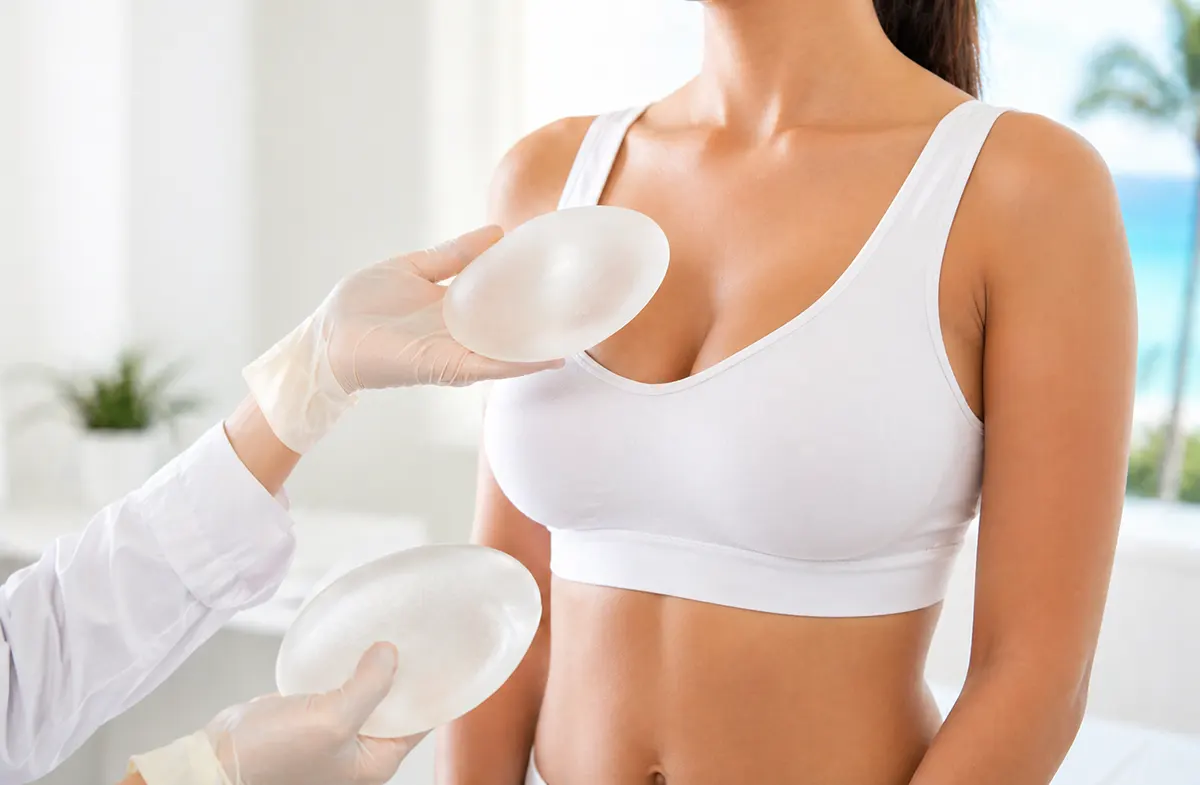
Breast implants in cosmetic consultation
Comparison of breast implants during a consultation for breast augmentation at an aesthetic clinic
A history of breast cancer is not necessarily an absolute contraindication, but it requires an interdisciplinary evaluation with the treating oncology team.
5. The step-by-step procedure
Augmentation mammoplasty is performed under general anesthesia and lasts between 60 and 90 minutes for standard cases, although it may be extended if combined with mastopexy—breast lift—or other additional procedures.
The most common approach is inframammary: an incision of approximately 3 to 5 centimeters in the natural crease under the breast, where the scar will be practically hidden. The periareolar approach—on the lower edge of the areola—is also common and leaves a scar that blends into the change in skin color. The transaxillary approach—in the armpit—eliminates any scarring on the breast but limits the type of implant that can be used.
The implant placement plane—subfascial, partial submuscular, or total submuscular—is decided based on the amount of the patient's own breast tissue, her morphology, and the surgeon's preferences. The partial submuscular (dual plane) approach is currently the most widely used because it combines the advantages of both techniques: natural coverage in the upper pole and natural breast movement.
The patient spends between one and two nights in the medical center for postoperative monitoring before being discharged with the recovery care protocol.
6. Recovery: Realistic Week-by-Week Timeline
The first two days are the most intense in terms of discomfort: chest tightness and pressure, moderate pain—especially when breathing deeply or moving your arms—and general swelling. These symptoms are expected and are managed with pain relievers prescribed by the surgeon.
During the first week, a surgical support bra prescribed by your surgeon will be worn. Sudden arm movements above the shoulders, physical exertion, and driving are to be avoided. International patients are generally cleared for their return flight between the eighth and tenth day.
Post-operative recovery with a compression bra after breast augmentation in Cancun
Use of a surgical bra and compression band after breast augmentation surgery for a safe and controlled recovery.
In the second and third week, the tension decreases considerably, and patients can resume low-demand daily activities. High-impact physical exercise is avoided for four to six weeks. Starting from the fourth week, with the surgeon's authorization, exercise can be gradually resumed, beginning with low-impact activities.
Implants take between three and six months to settle into their final position, a process known as dropping and fluffing: the implant slightly descends, and the lower pole of the breast acquires its final volume and roundness. During this period, the result may look higher or firmer than it will in its final state.
7. Costs in Cancun vs. USA: What's Included
The cost of breast augmentation in the United States ranges from $6,000 to $12,000, according to data from the American Society of Plastic Surgeons (ASPS) updated to 2023, considering only surgeon's fees. When adding anesthesia, operating room, implants, and hospitalization, the total cost in markets like Miami, Dallas, or Los Angeles can exceed $12,000 to $18,000.
In Cancún, the same procedure—with FDA-approved brand-name implants, a surgeon certified by the CMCPER, an anesthesiologist, an accredited operating room, and one night of hospitalization—costs an average of between $3,000 and $5,500 USD, depending on the type of implant chosen and the complexity of the case.
For international patients, even when factoring in the cost of round-trip flights and five to ten nights of accommodation in Cancun, the overall savings remain significant. Many patients use these savings to cover their travel expenses and still end up paying less than if they had undergone surgery in their home city.
In the CPSC, the budget includes: in-person pre-operative consultation, basic laboratory tests, surgeon and anesthesiologist fees, certified brand implants, operating room, one-night hospital stay, post-surgical bra, medications for the first 24 hours, and follow-up checkups during your stay in Cancun.
8. How to Choose the Right Surgeon
Choosing a surgeon is by far the most important decision in the process. Beyond price, there are objective criteria that every patient should verify before committing to a doctor for breast augmentation.
The first criterion is certification: the surgeon must have current certification from the Mexican Council of Plastic, Aesthetic, and Reconstructive Surgery (CMCPER), which can be verified in the institution's public directory. This certification guarantees that the doctor completed a plastic surgery residency at an accredited institution and passed the corresponding certification exam.
The second criterion is specific experience: a surgeon may be certified in general plastic surgery and have less experience in breast surgery. It is completely legitimate and recommended to ask how many breast augmentations they perform monthly, what techniques they typically use, and to view a portfolio of before-and-after cases.
The third criterion is communication and honesty: a good surgeon is one who also informs about what cannot be achieved, who points out the limitations of the procedure in each specific case, and who does not promise unrealistic results. Be wary of doctors who guarantee exact results or who downplay the risks inherent in any surgery.
9. Frequently Asked Questions
Do implants last forever?
Modern implants are designed to last for decades, but they are not guaranteed to be permanent for life. Current medical guidelines do not establish a mandatory replacement timeline if the implant is in good condition and there are no symptoms. However, any changes in breast shape, consistency, or symmetry should be evaluated with your doctor.
Can I breastfeed after a breast augmentation?
In most cases, yes. The inframammary approach and the submuscular plane do not interfere with the milk ducts or glandular tissue. The periareolar approach may have a greater impact in some cases. This is a point that should be discussed with the surgeon if the patient plans future pregnancies.
Does breast augmentation affect breast cancer detection?
Implants can partially obscure the visualization of breast tissue on a conventional mammogram. For this reason, patients with implants should inform their radiologist before the mammogram, who will then use specific implant displacement techniques. The presence of implants does not prevent cancer detection but requires this additional protocol.
What if I don't like the results?
If the result does not meet expectations—due to size, symmetry, or position—there is a possibility of revision surgery. However, doctors recommend waiting at least six months after the primary surgery for the implants to settle completely before considering any adjustments.
Can I choose the exact size I want?
The implant size is chosen together with the surgeon during the preoperative consultation, considering the patient's breast base, chest width, available breast tissue, and desired outcome. There are sizers—trial implants—that allow the patient to have a visual reference before deciding. The surgeon will guide on which sizes are anatomically suitable for each case.
Can I combine breast augmentation with liposuction?
Yes, it is possible to combine both procedures in the same surgical session. In fact, the package known as a Mommy Makeover often includes breast augmentation or lift, abdominoplasty, and liposuction. Combining them allows for shared anesthesia and operating room costs and recovery in a single period.
How long should I stay in Cancun?
For a standard augmentation mammoplasty without combined procedures, seven to ten days in Cancun is recommended. This allows for the surgery, overnight hospital stay, initial recovery days, and at least one follow-up check-up before the return flight.
Can the surgeon see me by video call before I travel?
Yes. The CPSC offers virtual pre-travel consultations where the surgeon reviews photographs, answers all the patient's questions, and develops a preliminary surgical plan. The in-person consultation takes place the day before surgery for final evaluation and signing of informed consent.
Breast augmentation is a personal and intimate decision, and it deserves to be made with complete information, a trusted surgeon, and total clarity about what the procedure can and cannot achieve.

